News
Every Medical Chronology We've Built Has Been Wrong
Every medical chronology CaseMark has produced was wrong. Not on the facts, on the format. We built the one we thought you wanted, but your firm already knows what it wants: your structure, your headings, your letterhead, the version every paralegal can open and go straight to the section they care about. Now you can have it that way. Custom medical summaries, included with Workspace and $25 to $100 on Source.
I'll start with the uncomfortable part. Every medical chronology CaseMark has produced up to now has been wrong.
Not wrong on the facts. Our summaries pull the right dates, the right providers, the right diagnoses, and they cite back to the page. Wrong in a different way. We built the chronology we thought you wanted. Then we handed it to you and expected you to use it.
That's backwards, and I should have known better. I'm married to an insurance defense attorney.
"Don't tell me how to practice law"
Early on, I was showing Sarah a summary format we were proud of. Clean sections, a nice table, a structure our team had spent weeks on. She looked at it and said something I've thought about every week since:
"Don't tell me how to practice law. Just give me the tools to do it my way."
That's the whole thing. A law firm doesn't need a software company's opinion on how a medical chronology should be organized. The firm already knows. They've been building these for 30 years. They have a format. It's on their letterhead. It has their headings, in their order, with their conventions for how a gap in treatment gets flagged or how a preexisting condition gets called out. The partner who reviews it knows exactly where to look because it's always looked that way.
So does every paralegal at the firm. Hand one of them a chronology in the house format and watch what happens. They don't read it front to back. They open it and go straight to the section they care about, because they've opened a thousand of these and their hands know where everything is. That muscle memory is worth more than any feature we could build. Pair it with a summary the AI produced in minutes instead of a week and you get the real payoff: the firm keeps every habit that already works and drops the part that was eating the hours.
When a vendor shows up with a different format, the firm has two options. Retype it into their template, which burns the time the software was supposed to save. Or live with a document that looks like it came from somewhere else, which it did.
Most firms picked a third option. They kept doing it the old way.
What we changed
CaseMark now does medical summaries two ways, and both are available in CaseMark Workspace and CaseMark Source.
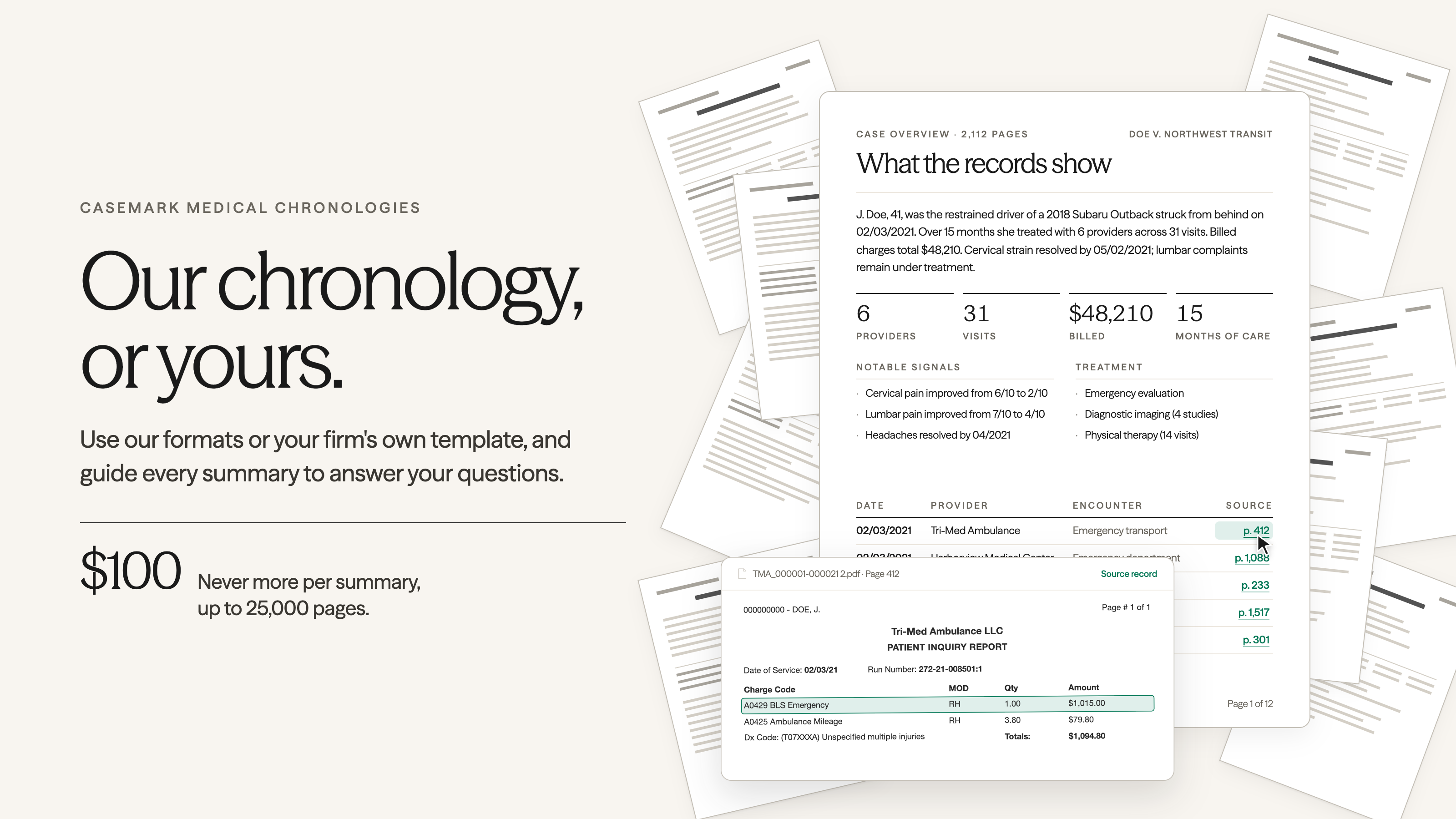
The first way is ours. We offer a comprehensive chronology, an injury-focused medical analysis, and a treatment-focused narrative, all cited to the source page. They're good. I can say that with some confidence because Sarah finally signed off on them, and she does not sign off on things.
The second way is yours. Send us a few examples of the chronology your firm actually uses, in your format, your organization, your structure, on your letterhead, and we'll build an easy button from them. After that it's one click, every matter, same output your partners and paralegals already know how to read. You never have to describe the format again.
Either way, you're not stuck with what comes out of the box. We've folded Insight Pass into every summary. Before anything gets drafted, you answer a few framing questions: who's the audience, which side are you on, what's the summary for, how much detail do you want. A causation timeline and a damages narrative come from the same records and look nothing alike. Insight Pass settles which one you're building before the drafting starts, and it works on our formats and on yours.
So: our summaries, your summaries, and all of them steerable to give you exactly what you want.
What it costs
For Workspace customers, all of it is included. Nothing extra. Throw 10,000 pages of medical records at it and you get them back the way your firm does it.
For Source, custom summaries start at $25 and cap at $100 per summary.
Why the price matters as much as the format
I've written before about where the cost of this work is headed, and the short version is: down, fast. Custom summaries used to be a services engagement. A vendor would quote you a per-page rate, take two weeks, and send a PDF. Getting it in your own format was an upcharge if it was available at all.
That model is over. When a firm can get a 2,000 page chronology in its own template for about the cost of a lunch, the question stops being "is this worth it" and becomes "why would anyone still do this by hand." There isn't a good answer. The only remaining reason to do it the old way was that the software made you change how you work. We've removed that reason.
The lesson, in case it's useful to someone else
We spent a lot of engineering effort building a good medical chronology. The effort wasn't wasted. But the most important improvement we ever shipped to it wasn't a better summary. It was getting our opinion out of the way.
Lawyers know what they want. Give them the tools to do it their way, then get out of the way.
If you want to see what your firm's chronology looks like coming out of CaseMark, send us your template. We'll build it like you like.