Medical chronologies

100,000 pages of records, one clear timeline.

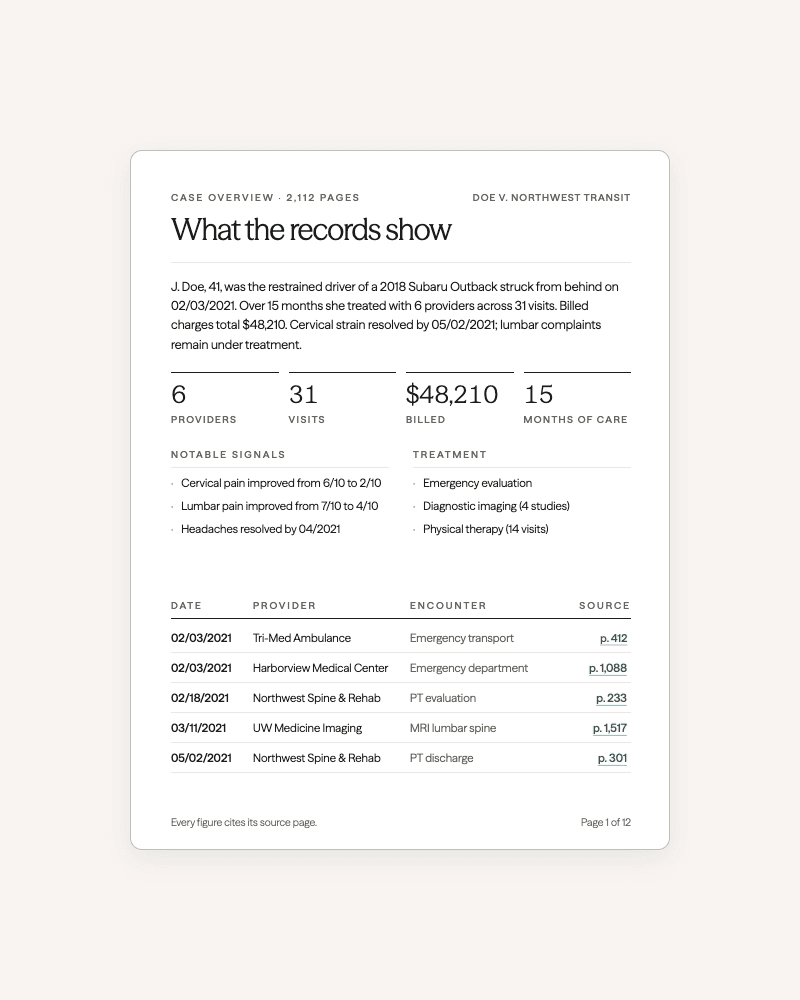
Every provider, ordered by date. Diagnoses with ICD codes, treatment history, medications, and vitals — with a page citation on every entry.

Trusted by litigation teams at
Ogletree DeakinsNelson MullinsPathway Law FirmPwC
A medical record analysis cover page with the patient summary, beside the dated medical chronology table
100k+ pagesSummarized in about thirty minutes
PDF or WordEvery entry cited to its source page
Ask it anythingInterrogate the chronology and the records with AI

Outputs feed the next piece of work: a chronology becomes the record base for demand letters, expert review, and motion practice.

Medical chronologies for record-heavy matters

Comprehensive analysis of patient medical records — visit details, diagnoses with ICD codes, treatment timelines, and clinical insights, organized chronologically so attorneys can focus on building the case.

Choose the right medical chronology format

CaseMark supports several medical chronology styles for different matter types and litigation needs.

Medical Analysis

Focus on injury-related medical events, treatment timelines, diagnoses, and outcomes for record-heavy injury matters.

  • Filters unrelated history to focus on the injury timeline
  • Tracks progression, gaps in treatment, and functional impact
  • Captures expenses, medication changes, and future care recommendations
Best for
  • Personal injury cases
  • Motor vehicle accidents
  • Causation analysis

Comprehensive Medical Chronology

A date-ordered timeline covering visits, diagnoses, treatments, medications, test results, and procedures with page citations.

  • Organized by date with clear timestamps for each medical event
  • Includes providers, facilities, and treating specialties
  • Captures medications, dosages, and changes over time
  • Documents imaging, tests, and major clinical findings
Best for
  • Extensive medical histories
  • Full medical context
  • Disability and workers compensation matters

Treatment Summary Chronology

Emphasize treatment decisions, interventions, and clinical outcomes where standard-of-care analysis matters.

  • Focuses on treatment decisions and clinical reasoning
  • Highlights deviations from protocols or guidelines
  • Captures referrals, consultations, and specialist recommendations
Best for
  • Medical malpractice cases
  • Treatment decision analysis
  • Deviation review

Medical chronology features

Process thousands of pages fast

Upload entire medical record sets and get organized chronologies in minutes instead of days of manual review.

Automatic date extraction

Identify and organize medical events by date to create a clean timeline of care.

Key findings highlighted

Flag important diagnoses, procedures, medications, and outcomes so teams can focus on what matters most.

Source page citations

Link each entry back to the original page for verification, motion practice, or expert review.

Multiple provider consolidation

Unify records from different facilities, specialists, and time periods into one coherent chronology.

HIPAA-conscious processing

Handle sensitive medical material with strong security and privacy expectations built in.

Interrogate

The chronology is only the beginning.

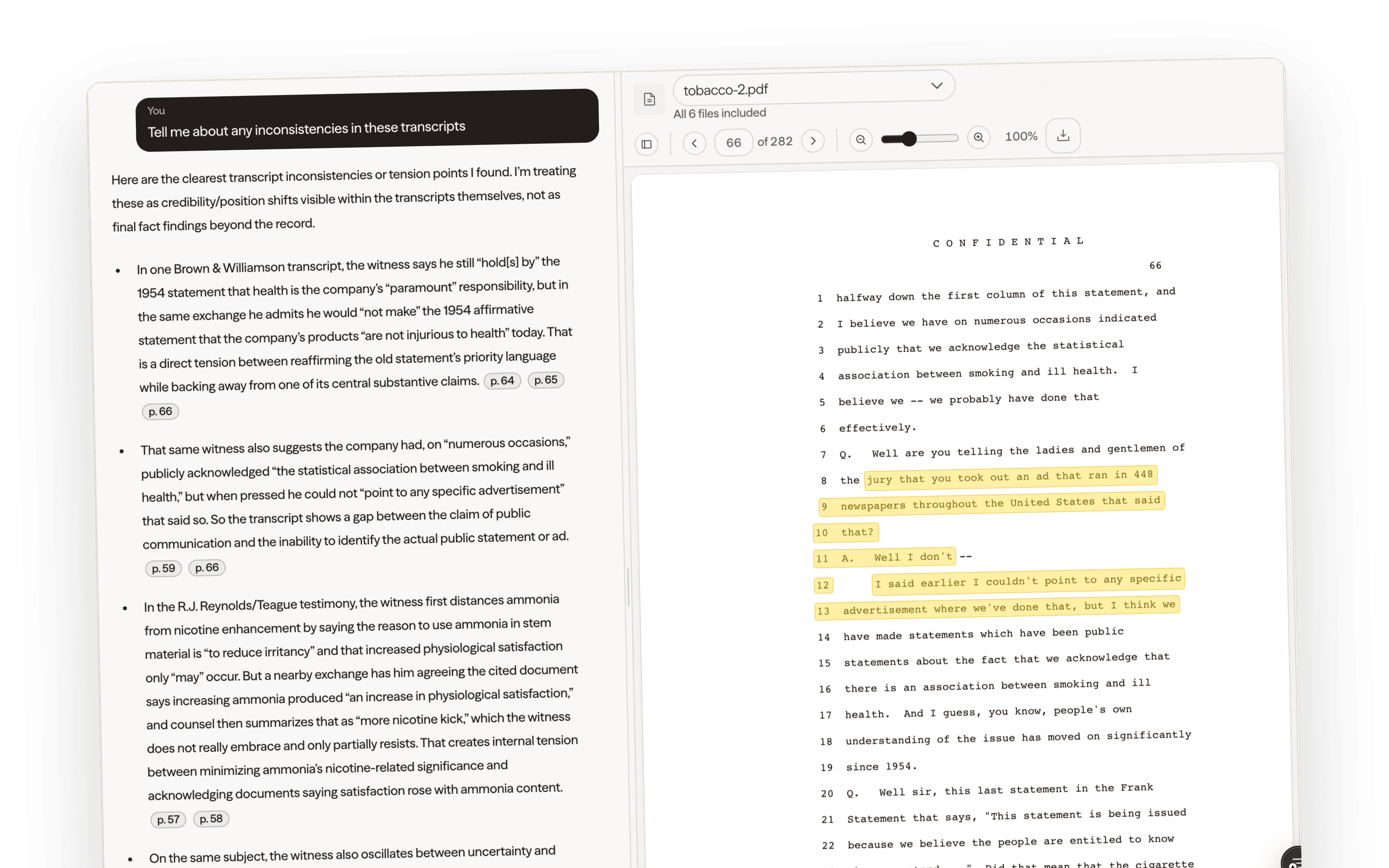
Every output includes “Interrogate this summary,” so you can ask AI follow-up questions across the entire medical record set—not just the events surfaced in the chronology. Trace diagnoses, treatment gaps, medications, prior conditions, or causation questions, with answers grounded in the records and linked to the supporting pages.

Included with every CaseMark outputAsk across the full subject matter · Follow every answer to the source
An Interrogate answer beside a source page with the cited passage highlighted
Add-on · Beta

Insight Pass: aim the chronology before it drafts

A causation timeline and a damages narrative come out of the same records looking different. Insight Pass settles which one you are building before drafting starts.

+$25/ summary

Framing questions on audience, side, purpose, and level of detail

Advanced reasoning for the planning step; cost-efficient models draft at volume

Access controlled per organization for beta groups, premium tiers, or firm-wide rollout

Works across medical chronologies, deposition summaries, indexes, and other workflows

Insight Pass framing questions with two of four answered, and the Run Insight Pass option showing plus twenty-five dollars
CaseMark Source

The same chronology, delivered under your brand

Source is the production and delivery platform for court reporting and litigation support firms: certify once, deliver every format, and let clients order work products from a branded portal.

Certification to package in one pass

All twelve transcript and litigation-support formats as one organized bundle.

Exhibit indexes start at draft

Source reads the record and prepares a reviewable index; your reporter approves it.

Interrogate the whole record set

Matter-scoped chat across the chronology and its source records, isolated per firm.

Your brand, your domain

880+ workflows clients can order from a portal that carries your name.

Enterprise medical chronology solutions

Need custom medical record analysis workflows, expert-facing summaries, or deeper litigation support integrations? CaseMark supports tailored deployments.

Medical chronology use cases

Use medical chronologies across injury, malpractice, disability, and settlement workflows.

Personal injury cases

Build timelines that show causation between incidents and injuries and support stronger damages storytelling.

Medical malpractice

Track treatment decisions and outcomes chronologically to surface delayed interventions or missed diagnoses.

Product liability

Connect medication usage, side effects, and adverse events across large record sets.

Workers compensation

Document injury progression, treatment compliance, and work restrictions throughout the claim lifecycle.

Social Security disability

Create detailed medical histories showing severity and persistence of disabling conditions over time.

Settlement negotiations

Present clear medical timelines that demonstrate injury severity, treatment cost, and overall case impact.

Medical chronology FAQ

Answers to common questions about medical chronology formats, preparation, review, security, cost, and use in litigation.

What is a medical chronology?

A medical chronology is a structured, date-ordered timeline of medical events, diagnoses, treatments, procedures, medications, and provider interactions. It condenses scattered records into a reviewable sequence showing what happened and when. Strong chronologies use neutral language and tie each entry to the underlying record so attorneys, paralegals, claims professionals, and experts can verify the facts.

How CaseMark handles it

CaseMark turns multi-provider medical records into a cited chronology with dates, providers, diagnoses, treatment history, medications, vitals, and direct references to the source page. The result is designed for legal-team review, not as a substitute for medical or legal judgment.

What is the difference between a medical chronology and a medical summary (or narrative summary)?

A chronology is a factual, date-ordered table showing the sequence of events, with each entry cited to the record. A medical summary or narrative groups events into prose and adds context around what happened and why it may matter. Chronologies emphasize verification and rapid review; narratives emphasize synthesis and storytelling. Many teams use the chronology as the factual spine and a narrative for demands, mediation, or trial preparation.

How CaseMark handles it

CaseMark offers a comprehensive medical chronology, an injury-focused medical analysis, and a treatment-focused chronology. Teams can choose the structure that fits the assignment while retaining source-page citations throughout the output.

Who prepares medical chronologies?

Paralegals and legal assistants prepare many chronologies under attorney supervision. Legal nurse consultants often handle medically complex files where clinical interpretation matters, particularly in malpractice and disputed-causation cases. High-volume firms may outsource the work or use AI-assisted tools with staff review. The right approach depends on record volume, medical complexity, and the degree of clinical judgment required.

How CaseMark handles it

CaseMark prepares the first structured, source-linked draft so legal staff can spend their time verifying entries and applying case judgment. Attorneys remain responsible for strategy, and medical opinions or causation conclusions remain with qualified clinicians and retained experts.

What should be included in a medical chronology, and what does the format look like?

The standard format is a table with one row per medical event. Core fields include date of service, provider or facility, encounter type, findings, diagnoses, treatment, outcomes, and a source reference. Complex matters may also track codes, medications and dosages, body parts, pre-existing conditions, and treatment gaps. Consistent dates, neutral wording, preserved medical terminology, and uniform citations make the chronology easier to trust and use.

How CaseMark handles it

CaseMark organizes every provider by date and can include diagnoses with ICD codes, treatment history, medications, vitals, procedures, tests, and page citations. Teams can choose a comprehensive, injury-focused, or treatment-focused output based on the matter.

How much does a medical chronology cost?

Pricing varies by record volume and delivery model. Manual work may be billed hourly, per page, or per case, while software commonly uses per-page or subscription pricing. The useful comparison is the complete reviewed cost: preparation, quality control, revisions, and the time needed to verify the result.

How CaseMark handles it

CaseMark Medical Summaries are pay as you go at $25 per summary plus $0.10 per source page. For example, a 2,000-page record set costs $225 before any optional add-ons. Current pricing is available on the CaseMark pricing page.

How long does it take to create a medical chronology?

Preparation time depends on page count, provider count, scan quality, and medical complexity. Manual review often takes hours or days, while AI-assisted systems can produce a first draft in minutes. Human verification remains part of the timeline. Record retrieval is a separate bottleneck; under the HIPAA right of access, covered entities generally must act on an individual's request within 30 calendar days, subject to the rule's extension provisions.

How CaseMark handles it

CaseMark can process record sets containing 100,000 or more pages in about thirty minutes, then gives the legal team a cited output to review. Actual end-to-end time still depends on source quality, missing records, and the team's verification process.

When and why do attorneys need a medical chronology?

Attorneys use chronologies during intake, case evaluation, discovery, deposition preparation, expert and IME review, settlement, mediation, and trial preparation. A chronology helps teams track multi-provider treatment, identify gaps and inconsistencies, organize damages evidence, and establish the factual foundation for downstream work. It should be refreshed when material records or major treatment events arrive.

How CaseMark handles it

A CaseMark chronology becomes a cited record base for demand letters, expert review, deposition preparation, settlement analysis, and motion practice. Interrogate also lets teams ask follow-up questions across the chronology and source records without losing the path back to the page.

Can AI create medical chronologies, and are they accurate?

Yes, but accuracy depends on both the system and the review workflow. A legal-specific tool should preserve source citations, avoid presenting medical opinions as facts, and make verification practical. AI output should be treated as a first draft: a paralegal, nurse, attorney, or other qualified reviewer should verify material entries against the record before relying on the chronology.

How CaseMark handles it

CaseMark generates a source-linked chronology and keeps page citations close to each finding. Reviewers can follow citations back to the record and use Interrogate to explain, research, or verify passages. CaseMark accelerates extraction and organization; it does not replace final human review.

Is a medical chronology HIPAA compliant, and is it safe to outsource medical records (including offshore)?

A chronology contains protected health information when it is derived from medical records. Before using any vendor, review the applicable agreements, encryption, access controls, audit practices, data residency, subcontractors, retention policy, and incident-response commitments. Offshore processing may introduce additional contractual, enforcement, or client-policy considerations, so organizations should evaluate it with privacy and legal counsel.

How CaseMark handles it

CaseMark is HIPAA compliant and SOC 2 Type II audited. Customer data is encrypted in transit and at rest, stored in the United States, and never used to train AI models. Organizations can review current controls and supporting materials through the CaseMark Trust Center.

Is a medical chronology protected work product, or is it discoverable?

Work-product treatment depends on why the chronology was created, who prepared it, what it contains, and how it is shared. Federal Rule of Civil Procedure 26(b)(3) protects qualifying materials prepared in anticipation of litigation, but the protection is not absolute and disclosure can affect it. Factual compilations, attorney mental impressions, and materials shared with experts may be treated differently. Counsel should make the privilege and disclosure determination for the specific matter and jurisdiction.

How CaseMark handles it

CaseMark preserves source citations and lets teams choose factual or more analytical formats, helping counsel keep the underlying record distinct from strategic commentary. Using CaseMark does not itself create or waive work-product protection; the legal team controls the purpose, content, access, and disclosure of the output.

Are medical chronologies admissible as evidence?

A working chronology is usually a case-preparation tool, not automatically substantive evidence. A court may allow a timeline as an illustrative aid under Federal Rule of Evidence 107, while a qualifying summary of voluminous admissible materials may be offered under Rule 1006. The foundation, disclosure, accuracy, underlying records, local rules, and purpose of the exhibit all matter. Counsel should decide how a particular chronology may be used in court.

How CaseMark handles it

CaseMark outputs are built for verification: entries remain tied to source pages, and PDF or Word exports can be reviewed and edited before use. CaseMark does not determine admissibility; it helps the legal team validate the factual support behind any proposed timeline, chart, or summary.

How should I organize medical records before creating a chronology?

Start with the most complete record set available from every provider. Make scans searchable where practical, distinguish true duplicates from legitimate same-day encounters, use consistent page or Bates references, and keep a gap log for missing pages, dates, or providers. Input quality directly affects chronology quality, so preserve originals and document any cleanup decisions.

How CaseMark handles it

CaseMark consolidates events from multiple facilities, specialists, and date ranges into one chronology. Complete, legible records produce the strongest result; page citations then make it easier to identify missing material and verify each extracted event against the uploaded source.

Should chronology entries link back to the source records (Bates numbers and hyperlinks)?

Yes. Source citation is one of the most important quality indicators in a chronology. Each material entry should identify the exact record page through a page number, Bates number, exhibit reference, or hyperlink. The convention matters less than consistency and reliable resolution back to the source.

How CaseMark handles it

CaseMark places a page citation on each chronology entry and supports outputs that link findings back to the underlying record. That lets reviewers move from the timeline to the source during expert review, deposition preparation, settlement analysis, or a challenge from opposing counsel.

Which practice areas use medical chronologies?

Medical chronologies are common in personal injury, medical malpractice, workers' compensation, mass tort, product liability, insurance defense, Social Security disability, and wrongful death matters. Their role varies by practice area, but the common need is the same: turn dense, multi-provider records into a factual timeline that can be reviewed and verified.

How CaseMark handles it

CaseMark supports chronology formats for injury and causation review, treatment-decision analysis, disability matters, settlement preparation, and broader record-heavy litigation. Teams can choose a comprehensive timeline, injury-focused analysis, or treatment-focused chronology.

How does a chronology handle treatment gaps, pre-existing conditions, and causation?

A strong chronology includes relevant pre-incident records, identifies the first post-incident encounter, and makes treatment gaps and changes in condition visible. This helps the legal team compare baseline health with later findings and evaluate competing causation narratives. The chronology organizes the evidence; a qualified expert supplies any medical causation opinion.

How CaseMark handles it

CaseMark's injury-focused Medical Analysis filters unrelated history, tracks treatment progression and gaps, and surfaces pre-existing conditions, functional impact, medication changes, and future-care recommendations with citations. Interrogate can then search the record for the passages supporting or complicating a causation theory.

How many pages of medical records does a typical case involve?

Record volume varies widely. A focused injury matter may contain a few hundred pages, while disability, malpractice, catastrophic-injury, and multi-provider matters can reach thousands or tens of thousands of pages. Volume alone does not determine difficulty; duplicate records, poor scans, numerous providers, and conflicting histories also add complexity.

How CaseMark handles it

CaseMark is designed for large record sets and can summarize 100,000 or more pages in about thirty minutes. Medical Summary pricing remains page-aware at $25 plus $0.10 per source page, so teams can estimate cost directly from record volume.

What are the most common mistakes in medical chronologies?

Common mistakes include missing citations, inconsistent dates, duplicate events, omitted prior conditions, altered medical terminology, over-summarized entries, overlooked contradictions, and stale timelines that do not include new treatment. A chronology should be more than an appointment list: it should be a connected, source-supported account that remains neutral enough to verify.

How CaseMark handles it

CaseMark standardizes dates, consolidates providers, highlights key findings, and places citations on entries. Interrogate can help locate contradictions, gaps, or prior mentions, but the legal team should still verify the final chronology and update it when the record changes.

Should we build chronologies in-house, outsource them, or use software?

Each model has tradeoffs. In-house preparation maximizes control but consumes staff time. Outsourcing shifts the review burden and may add clinical expertise, but introduces cost, turnaround, and vendor-governance considerations. Software keeps the workflow with the legal team and accelerates the first draft, but still requires disciplined human quality review.

How CaseMark handles it

CaseMark is the AI-assisted in-house option: upload the records, choose the chronology style, receive a cited first draft, and keep review with your paralegal, nurse, attorney, or expert. Pay-as-you-go pricing lets teams use it matter by matter without committing every file to the same production model.

In what formats and deliverables do chronologies come?

Common deliverables include editable tables, PDFs, and narrative summaries. Table chronologies favor quick review and citation, while narratives favor context and readability. Teams may pair them with provider lists, billing summaries, deposition summaries, expert materials, or demand packages. The right format depends on the audience and the next piece of legal work.

How CaseMark handles it

CaseMark exports medical chronologies in editable Word or PDF formats with source-page citations. Available structures include a Comprehensive Medical Chronology, injury-focused Medical Analysis, and Treatment Summary Chronology, with custom and enterprise tailoring available for specialized workflows.

How often should a medical chronology be updated?

Treat the chronology as a living work product. Update it when material records arrive or when the patient undergoes significant treatment, testing, surgery, or a change in work or disability status. Refresh it before major events such as a demand, deposition, expert review, mediation, or trial, and preserve enough version discipline to identify what changed.

How CaseMark handles it

When new records arrive, run a new CaseMark chronology or analysis against the updated record set, then review the new entries and citations before replacing the prior work product. This keeps the timeline current without manually rebuilding the entire chronology from scratch.

Ready to transform medical record review?

Build usable chronologies from complex record sets in minutes instead of days.