Features
Aim the Report Before It Drafts: Introducing Insight Pass
An AI workflow can produce a report that is technically complete and still not the report you needed. Insight Pass fixes that at the front of the workflow: before a report drafts, it reads your sources and asks a few quick questions about audience, side, and purpose, so the first draft comes back aimed at what your team actually needs.
Every litigation-support team knows the moment. A workflow runs, the draft comes back, and it is technically complete but not quite right. The chronology is accurate but it does not lead with the facts that matter for this claim. The deposition summary is thorough but reads like a neutral recap when what you needed was impeachment material. Nothing is wrong with the record. The draft simply did not know where you were aiming.
The usual fix is to write a better prompt. That works, but it puts the burden in the wrong place. It asks a busy production team to become prompt engineers on top of everything else they already do, and it front-loads a task that most people would rather skip. So they skip it, and the rework happens later.
Insight Pass moves that burden into the product.
What Insight Pass does
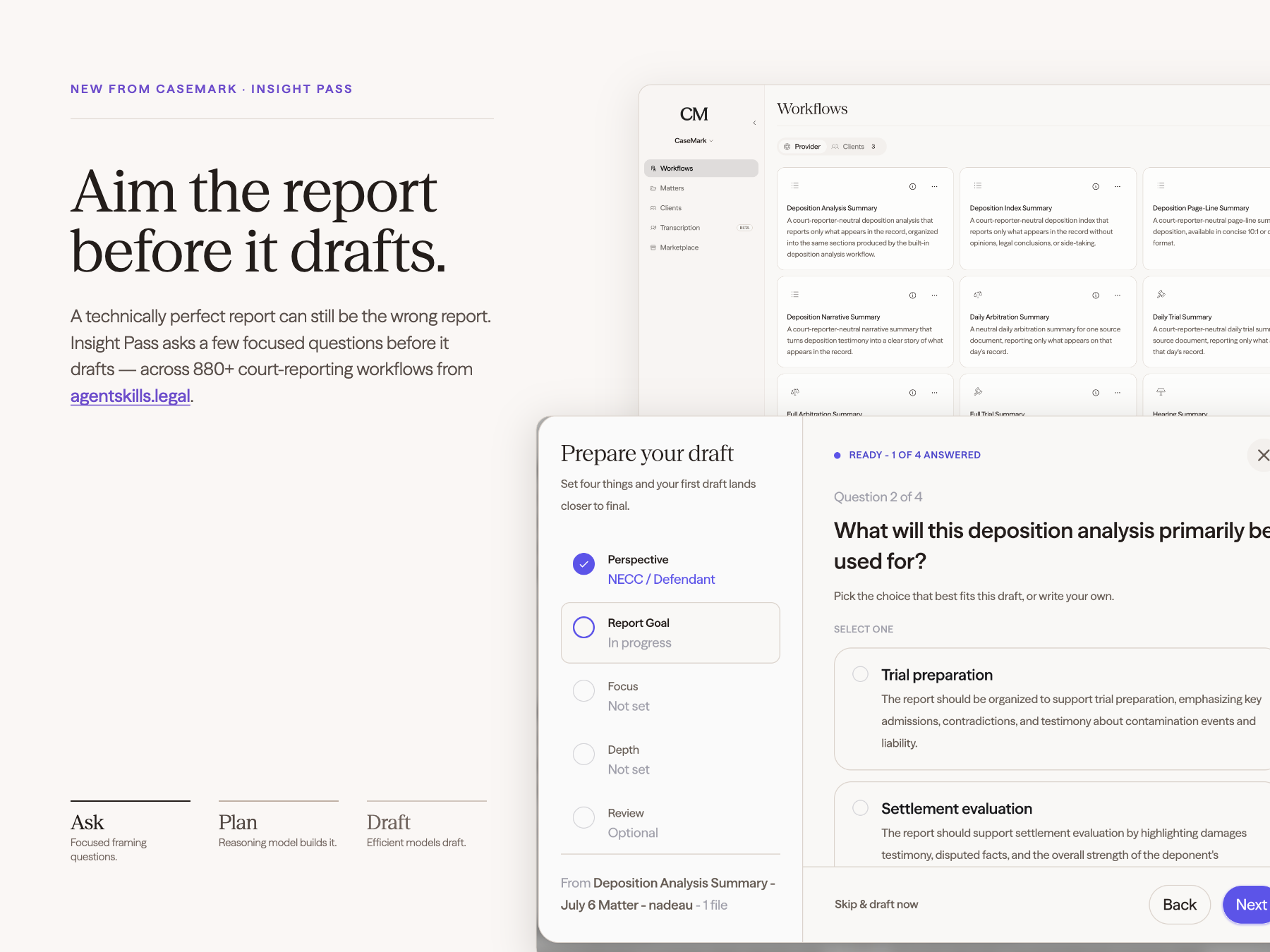
Insight Pass is an optional guidance step that runs before a workflow drafts. It reviews the selected matter sources and the workflow you chose, then asks a short set of framing questions, usually three or four, with quick-answer options you can tap in seconds. You can pick a suggested answer, write your own, or add free-form direction if you want to be specific. If you are in a hurry, you can skip the questions and draft immediately.
The questions are the kind of judgment that is not always obvious from the record alone. Who is the audience? Which side are you supporting? Is the goal a neutral summary, issue spotting, trial prep, settlement posture, or impeachment? How much detail do you want? Insight Pass captures that intent at the right moment, then hands the workflow a much clearer picture of what a useful deliverable looks like.
It works on single work items and on batch runs, so a daily packet of transcripts or reports can each get its own pass. It is controlled per organization, which makes it easy to roll out to a beta group, a premium tier, or your whole team.
The right model for the right job
There is a deliberate design decision behind Insight Pass, and it is one that matters more every month as model costs move. The hard part of any good report is not the writing. It is the thinking: reading the sources, understanding what the Provider is actually trying to accomplish, and deciding how the deliverable should be structured to serve that goal.
So that is exactly where we spend the expensive compute. Insight Pass uses an advanced reasoning model to frame the questions, interpret your answers, and build a concrete plan for the work product. That plan then guides token-efficient models that carry out the drafting at scale.
The payoff is the combination most teams assume they have to trade off against each other. You get the judgment and accuracy of a top-tier model at the moment it counts, and the cost efficiency of lighter models across the volume of pages where they do the work just as well. Highly accurate output, without paying premium rates for every line of every draft. As the AI market keeps sorting out the balance between capability and cost, that architecture is how we keep premium work product affordable at volume.
Here is how that plays out in two of the workflows where purpose changes everything.
Example 1: Deposition summaries
A single deposition transcript can become very different documents depending on why you need it.
Run a deposition summary without guidance and you get a solid, neutral recap of testimony. Useful, but generic. Run the same transcript through Insight Pass and it asks who the summary is for and what you are trying to accomplish. You answer that you represent the defense, the priority is impeachment, and you care most about inconsistencies between this testimony and the plaintiff's prior statements.
Now the draft leads with contradictions, flags testimony that opens the door for cross, and organizes the summary around the points you will actually use. Same transcript, same workflow, a report that arrives aimed at the job instead of at the average.
Example 2: Medical chronologies
Medical records are where purpose matters most, because the same file supports completely different arguments.
A defense team preparing to challenge causation needs a chronology that surfaces preexisting conditions, gaps in treatment, and inconsistencies in the reported mechanism of injury. A team building damages needs the opposite emphasis: continuity of care, the progression of symptoms, and the treatment burden over time. The records do not change. The useful chronology does.
With Insight Pass, the framing questions capture that intent up front. Tell it the side, the theory, and the date range that matters, and the chronology comes back organized around the argument you are building rather than as a flat, chronological transcription of every visit. That is the difference between a draft your team has to rework and a draft your team can use.
Better first drafts, less prompt writing
Insight Pass is not a chat product and it is not a replacement for source-grounded review. It is a quality-control and rework-reduction step that lives inside the workflows you already run. It studies the sources, asks the right questions, and gets out of the way. The payoff is simple: work product that lands closer to intent on the first pass, with less prompting and less back-and-forth.
Insight Pass is rolling out now, controlled per organization. If you would like early access for your team, reach out and we will get you set up.