Features
Not Another GPT Wrapper: What Linc Says About How We Build CaseMark
The legal AI market is full of GPT wrappers. They demo well and fall over the moment a lawyer asks for real work. Here is why CaseMark is built on a different foundation, and what our open-source agent Linc reveals about the infrastructure underneath.
The legal AI market is full of GPT wrappers. You know the pattern. Take a chat box, put a single model behind it, add a legal-sounding prompt and a clean UI, and call it a product. It demos well. It falls over the moment a lawyer asks it to do real work across real documents and real systems.
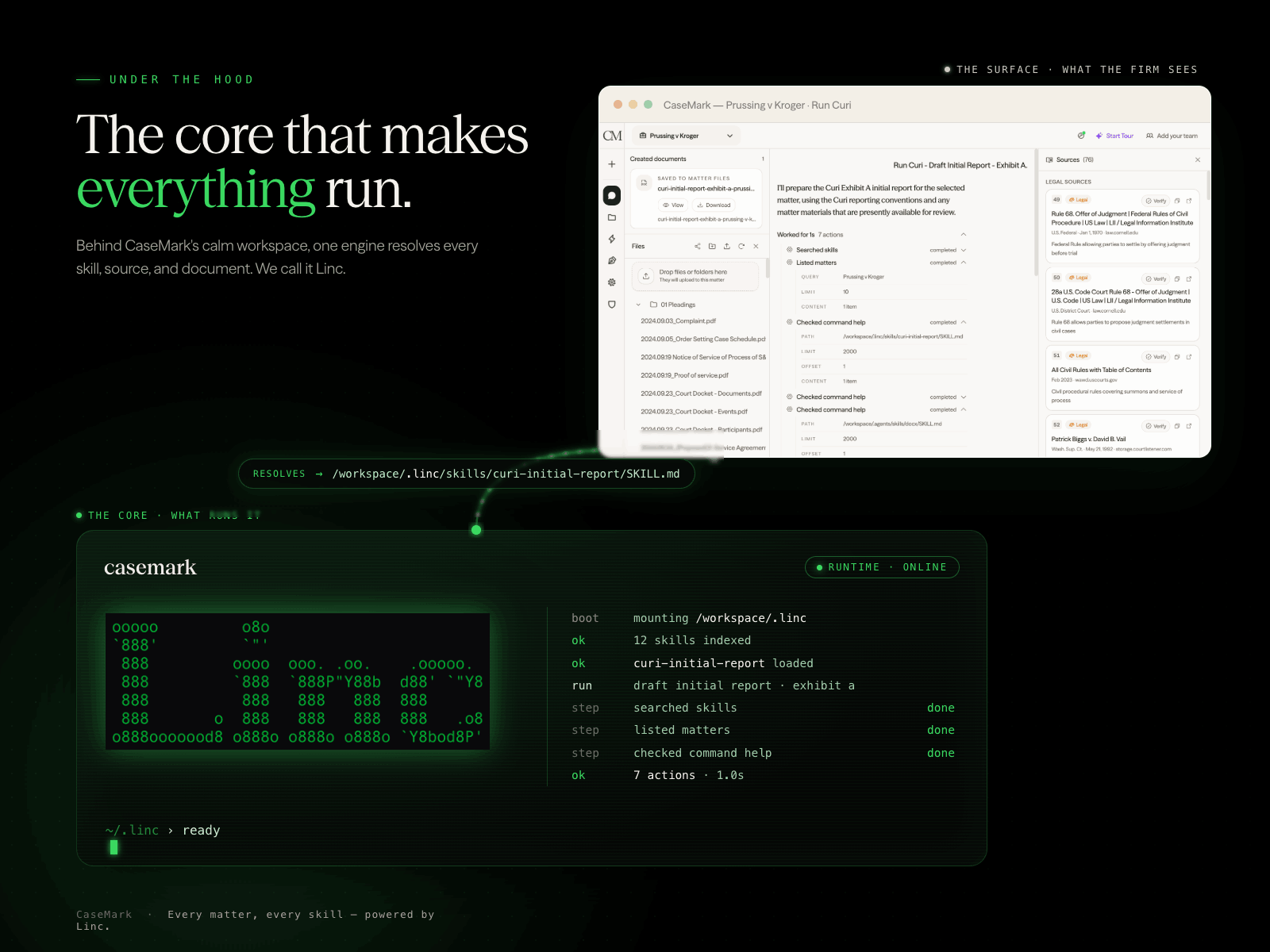
We built CaseMark to be the opposite of that. The clearest way to show you what I mean is to talk about Linc, the open-source legal AI agent we just shipped, and what it reveals about the infrastructure underneath app.casemark.com.
What Linc actually is
Linc is a legal AI agent that lives in your terminal. You install it, authenticate with your case.dev account, and you have an agent with access to 195+ models behind a single API key.
Here is the part that matters. Linc is built on pi, the open-source agent harness created by Mario Zechner. Pi is not a toy. It has tens of thousands of stars, a real community hardening it, and close to two hundred releases. It is a serious, battle-tested agent runtime: a unified multi-provider model API, an agent core that does genuine tool calling and state management, and a terminal interface built for actual work.
We did not reinvent the agent runtime. We took a proven one, pointed it at case.dev as the model gateway and the skills layer, and tuned it for legal. That choice tells you everything about how we think.
Why a harness beats a wrapper
A GPT wrapper is a prompt in front of one model. A harness is a runtime that lets an agent reason, call tools, touch your files and systems, hold state across a multi-step task, and produce structured, defensible output.
Legal work is never one step. Privilege review, deposition summarization, claims triage, citation checking, and matter production all require pulling documents, calling services, applying domain logic, and writing results you can stand behind. A chat box cannot do that. An agent harness can.
This is the difference between software that talks about your case and software that does the work on your case.
One key, 195+ models, zero lock-in
Here is something most legal AI vendors will not tell you: betting your firm on a single model is a liability, not a feature.
Different legal tasks have different needs. Some demand the highest reasoning accuracy regardless of cost. Some need to run cheaply at high volume. Some are latency-sensitive. When you are locked to one model, you compromise on all of them.
case.dev sits in front of 195+ models with one key, so the right task goes to the right model, and you are never trapped when a better or cheaper model ships next quarter. The model layer becomes a commodity you control, not a vendor that controls you. That is the same open-standards thesis I have been building toward my entire career, going back to OpenID and OAuth. The value is never in owning the pipe. It is in the standards and the work that flow through it.
The skills are where the law lives
Models are general. Legal work is specific. The intelligence that makes CaseMark useful does not live in the model, it lives in the skills.
Through agentskills.legal, our agents can call a growing library of legal AI skills over MCP. Comparative document analysis, claims triage workflows, jurisdiction-aware tasks, and more. These are the encoded, reusable units of legal expertise that turn a general model into something a litigation team can actually rely on. Linc and app.casemark.com both draw from the same skills layer, which means the work is consistent, inspectable, and improvable over time.
A wrapper has a prompt. We have a registry of legal skills, an agent runtime to execute them, and a model gateway to run them on whatever model fits. Those are not the same category of thing.
Built on open standards, on purpose
Linc is MIT licensed and built on open source. That is not an accident, it is the brand.
When you sell into legal, trust is the entire game. AI-cautious buyers do not want a black box making decisions inside their privileged workflows. Open infrastructure, an auditable runtime, and a transparent skills layer are exactly what earns trust with both the technical buyer and the general counsel. case.dev is the open legal AI platform. agentskills.legal is the open registry. Linc is the open client that shows how they fit together in a single install.
And underneath all of it, the infrastructure is SOC 2 Type II and HIPAA certified, because open and serious are not opposites. They are requirements.
What this means for app.casemark.com
When you use CaseMark, you are not using a thin layer over someone else's model. You are using a product sitting on top of real infrastructure:
A model gateway with 195+ models and no lock-in. A skills registry that encodes actual legal expertise. An agent runtime that does the work instead of just describing it. Security and compliance built for regulated work.
Linc is the proof point. It takes that entire stack and makes it installable in one command, drivable from a terminal, and open for anyone to inspect. The fact that we can hand you the front door as open source is the clearest signal we can give about what is behind it.
The market is going to keep shipping GPT wrappers. They will keep demoing well and disappointing in production. We are building the layer those wrappers wish they had, and we are building it in the open.
If you want to see it, Linc is on GitHub at github.com/CaseMark/linc, and the platform it runs on is at case.dev. The product it powers is at app.casemark.com.
Come build on the standards layer with us.