Features
Capture, Certify, Deliver: The Agency is the Platform
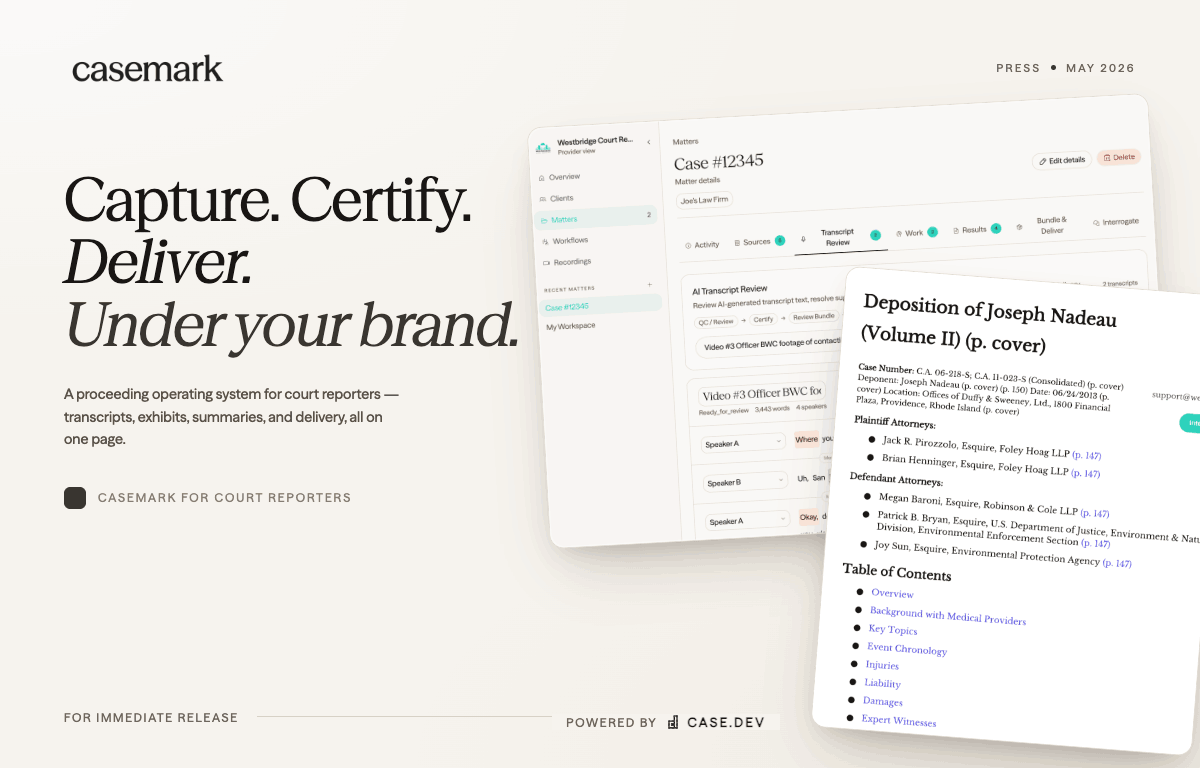
Today we're expanding CaseMark for Court Reporters with a certification workflow, a matter workspace for law firm clients, and a 10% referral to agencies.
For most of the last decade, the court reporting agency has operated as a vendor in a transaction. The agency provides the reporter, captures the proceeding, delivers the transcript, sends the invoice, and waits for the next case. That model fit a world where transcripts were the only artifact and a deposition was a one-day event with a single deliverable.
The work has changed since then.
Law firm clients now expect summaries, chronologies, exhibit reviews, deponent profiles, and search across an entire matter. They expect those artifacts to land in their tools and their workflows rather than in a separate portal. They expect the AI work product to be governed, auditable, and signed off by someone they can name. And they expect all of this without giving up the certified transcript the case ultimately stands on.
Agency owners we talk to feel the squeeze. They are being asked to underwrite a much bigger workflow with the same per-page economics they had ten years ago. They are watching law firm clients buy AI tools directly, capturing none of the upside themselves, and being asked afterward to integrate with whatever the firm picked. They are fielding hard compliance questions from general counsel and risk committees, and they need substantive answers.
So we approached the problem from a different angle. What does an operating system for a court reporting agency look like when the agency is positioned as the platform, with its own intelligence layer and its own economics that allow them to realize more of the value in the Litigation Lifecycle?
The answer has three parts. We are announcing all three today.
Part one: capture, certify, deliver
CaseMark for Court Reporters has really just been a summary solution after the deposition. Today we are formalizing the the capture, certify and delivery steps as part of our platform.
A certified transcript is a legal artifact. It carries the reporter's attestation, a chain of custody from the moment of capture through every hand that touched the file, and the evidentiary weight that lets the record stand up in court. Summaries and search indexes are useful companions to the record, but the certified transcript remains the record itself.
CaseMark's certification workflow puts the reporter at the center. Capture flows into a structured scoping and proofreading queue. Reporters sign off on the finalized transcript . Every revision, every re-cert, every distribution event is logged and reproducible. The AI-assisted artifacts that ride alongside the transcript, summaries, chronologies, exhibit reviews, all carry a clear provenance back to the certified source.
The certification workflow runs on CaseMark's SOC 2 Type II controls and our HIPAA-aligned data handling posture. These are the controls that let an agency owner answer "yes" when a Fortune 500 general counsel asks whether AI can touch the transcript at all.
Part two: CaseMark Workspace
A lot of deposition technology is built around a single proceeding. You schedule the deposition, you host the deposition, you generate artifacts from the deposition, and the deposition lives in a portal until somebody needs it again.
Lawyers think in matters, not depositions. A matter is a case. A case has dozens of depositions, hundreds of exhibits, thousands of documents, multiple deponents, parallel chronologies, evolving theories, and a team that has to stay coordinated across all of it for years.
CaseMark Workspace is built around the matter. Every deposition lives inside its matter. Every exhibit, summary, chronology, deponent profile, and AI artifact is searchable across the matter. The library of legal skills at agentskills.legal is available inside the matter, so litigators can run repeatable, governed workflows on their own data. When a new deposition lands, the matter picks it up automatically.
For an agency, this changes the conversation with the law firm client. You are not delivering a standalone PDF. You are delivering the unit of work the firm cares about into the workspace the firm already operates in. The transcript becomes more useful. The relationship becomes stickier. The next deposition books faster.
Part three: 10% to the agency
Court reporting agencies are the most credible channel into the law firm buyer in litigation services. Agency owners know the partners, know the paralegals, know which firms care about technology and which firms don't, and have the trust required to introduce a new tool. That credibility has real value, and we think it should be compensated.
Starting today, when a court reporting agency brings a law firm client onto CaseMark Workspace, the agency receives 10% of the recurring revenue from that firm's Workspace seats. The payment is monthly. It continues for the life of the customer. There is no cap. If you refer ten seats today and a hundred seats next year, the math compounds.
We have heard from agency owners that the most useful thing about this mechanic is not the dollars on a single referral, although those add up. It is the strategic alignment. When the agency makes money on the law firm's success with the platform, the agency has a reason to teach the firm how to use it well. Adoption goes up. Retention goes up. Both sides win.
How this lines up against the rest of the market
A new category of agency platforms is emerging in court reporting AI. Most pair Zoom-based deposition hosting with exhibit display and a real-time speech-to-text feed. That combination is useful for a single proceeding. We think an operating system for an agency needs to do more.
What an agency should look for in a platform partner is specific. A certification workflow that puts the reporter at the center of the record, with auditable chain of custody. A matter workspace that law firm clients will actually adopt and pay for on their own. A referral economic that pays the agency for the channel it provides. A compliance posture, in writing, with attestations a general counsel can rely on. Integrations that work both ways, not thin one-way pushes. An open platform with documented APIs and a skills library the agency can extend.
Those are the criteria we built CaseMark against, and they are a fair test for any platform an agency is evaluating today.
What's available today and what comes next
CaseMark for Court Reporters with the certification workflow, CaseMark Workspace, and the 10% referral mechanic are all generally available today. Agency owners can book a demo at casemark.com/court-reporting.
Over the next few weeks, we will publish more on the certification workflow architecture, including the chain-of-custody data model and how reporter attestation is encoded. We will also publish a partner kit for agencies who want to onboard their law firm clients quickly, with co-branded materials, an explainer for partners, and a referral dashboard so you can see your earned share in real time.
If you are in Nashville at the NNRC on Thursday, thank you for the candor. If you stop by our booth at Unity Summit Thursday through Sunday, thank you in advance for the time. A few of you asked us to put this in writing, and this is us doing that.
Capture, certify, deliver, with intelligence built in and an economic that respects the relationship the agency has earned. That is the operating system we think the next decade of court reporting can run on, and we built it to run on yours.
Book a demo: casemark.com/court-reporting
Follow up from NNRC May 14th: scott@casemark.com
Visit our booth Thursday May 14th through Sunday May 17th at Unity Summit, Renaissance Nashville Hotel.