News
Saying the Quiet Part Out Loud
Every month we send customers a one-page report showing what they got for their money. Here is the most recent one: 38 practitioners, 841 hours back, $3,500 a month. The quiet part is not the price.
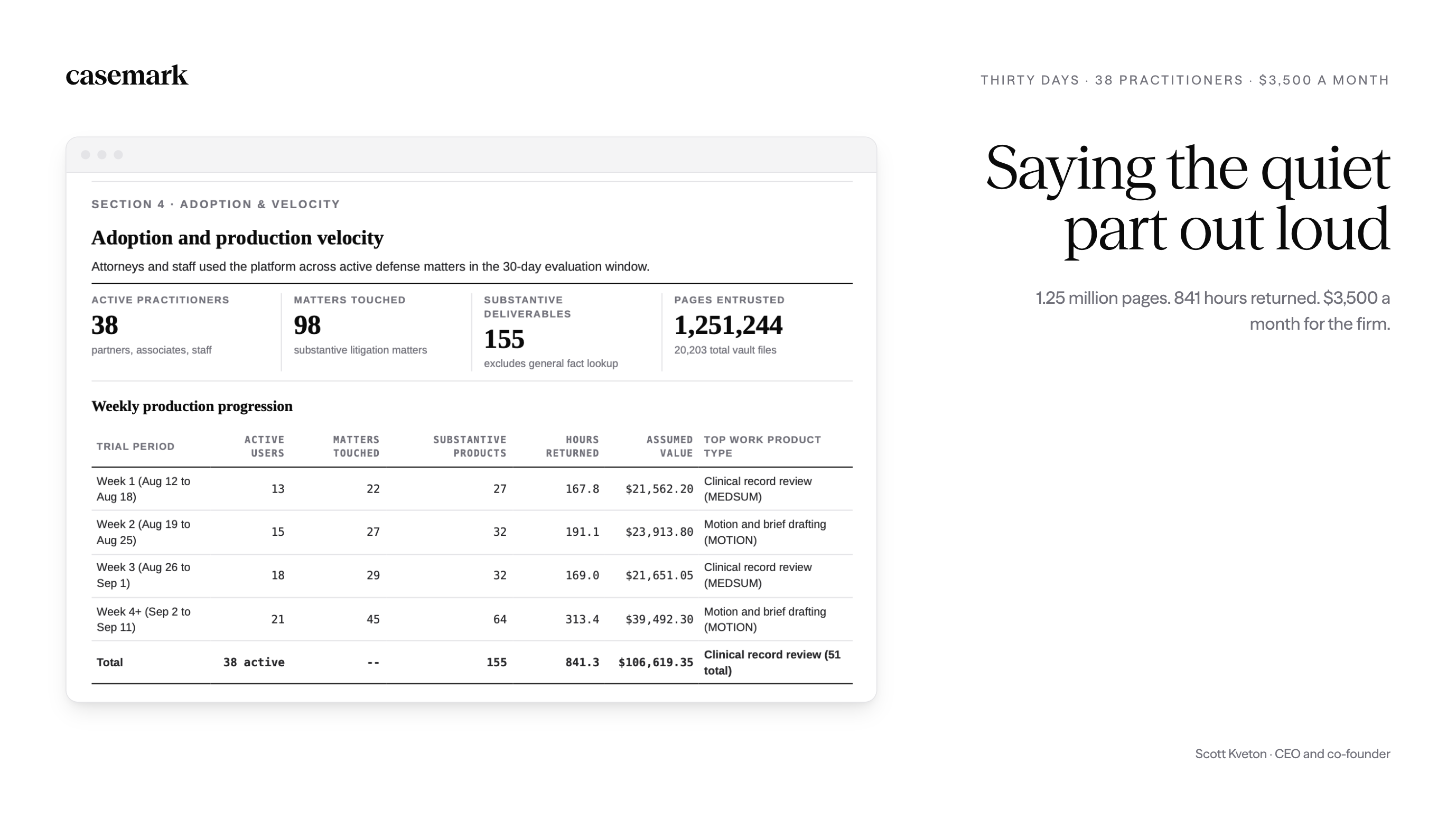
Every month we send customers a one-page report showing what they got for their money. Here is the most recent one, from a mid-sized insurance defense firm. Partners, associates and staff, working real matters. August 12 to September 11.
- 38 active practitioners
- 98 substantive litigation matters touched
- 155 substantive deliverables produced: medical record reviews, motions, briefs. Not general fact lookup.
- 1.25 million pages of client documents loaded and worked against
- 841 attorney hours the firm did not have to spend
The number I care about is the trend inside the month. The first week was 13 users and 27 deliverables. The last week was 21 users and 64 deliverables. Nobody ran a change-management program. People watched the person next to them and started using it.
Using the firm's own blended rates, those 841 hours pencil out to about $106,000. That is an assumed value. Nobody counts hours they didn't spend, and in insurance defense a lot of that time would have been billed to a carrier. I am not claiming it landed as cash in the firm's account. The direction is not in question, and the firm can see why on one page.
All in, they pay $3,500 a month. Not per seat. Not per matter. Not a meter that spins while a paralegal uploads a deposition. $3,500 for the firm.
Attorneys and staff onboard themselves. Nobody at the firm had to become an AI administrator. The models are open-weight and hosted in the United States, so client data does not leave the country and does not train anyone's frontier model. SOC 2 and HIPAA, BAAs signed as a matter of course, because insurance defense means medical records. We also build the workflows the firm actually runs. If they leave, those skills go with them. They're theirs.
We carry healthy SaaS margins at that price. The models are commoditizing. The infrastructure is a solved problem. The hard part is knowing what a good med chron looks like, what a motion in limine needs, and what a carrier's reporting guidelines require. That is domain knowledge. That is what we charge for.
If a vendor tells you legal AI has to cost six figures a year, ask what the money is for. If the answer is the model, they are overpaying and passing it on. If the answer is sales and marketing, you are funding their growth, not your firm's.
This matters now because carriers have done the same math. Starting January 2027, a major carrier is requiring AI on matters across its defense panel, on the order of 300 firms. We are on that list today. Required to use AI is not the same as required to use us, and I do not expect to be the only name on it forever. Carriers are not doing this because AI is fashionable. They pay the defense bills. A $3,500-a-month tool, actually used, changes allocated loss adjustment expense across a panel. Firms that treat the mandate as a box to check will have a harder decade than firms that treat it as a head start.
The quiet part is not the price.
When 38 people get 841 hours back in a month, the firm has a decision to make. Bill the time somewhere else. Take on matters they used to turn down. Stop hiring for the roles that just got lighter. None of those choices are neutral. The hourly model was built on the assumption that the work takes the time it takes. That assumption is now false for a growing share of insurance defense work. Most firms know this. Few have said it to their partners yet.
We price it where it should be, build the trust layer firms actually need, and send a report every month that makes the argument. This one did.